.png)
Data Centers in a Finite Landscape
Data centers, Blaine County's moratorium, and lessons from Meta's new facility in Kuna


Data centers feel like the buzz word boogeyman lately, which is timely for October. But it got me wondering, how much water does the internet use?
It’s a strange and unanswerable question.
We tend to imagine the digital world as something that exists somewhere above us—in “the cloud.” Emails, photographs, streaming movies, artificial intelligence, and the billions of searches and digital transactions we make every day can feel almost weightless. But the cloud has a physical address. It exists in enormous buildings filled with servers. Those servers require electricity. They produce heat. And depending on how they are cooled, keeping them operating can require water—sometimes a lot of it.
That connection has recently become much less abstract here in Blaine County.
In September, Blaine County began developing new land-use regulations for data centers. The County subsequently approved an emergency moratorium that would temporarily halt new data-center building and development applications while permanent regulations are developed. The draft specifically identifies water, electricity, air pollution, building size, noise, parking, and traffic as issues requiring consideration. For those of us who spend a lot of time thinking about the Big Wood River, this raises some interesting questions.
What exactly does a data center require? Where do those resources come from? And in a place where land and water are already limited, how should we think about the tradeoffs that come with this new kind of infrastructure?
First: What Exactly Is a Data Center?
At its simplest, a data center is a building—or collection of buildings—filled with computer servers and all of the infrastructure needed to keep them operating. The cloud may feel intangible, but data is ultimately physical. Every email, photograph, video, financial record and AI model is information encoded as numbers and stored as physical states on electronic hardware somewhere. That hardware requires land, electricity and cooling. Follow the chain far enough, and even something as seemingly weightless as this blog post eventually has a physical footprint (whoops).
Data centers support far more than entertainment or social media. Banking systems, medical records, telecommunications, government services, scientific research, cloud computing, cybersecurity, commerce, weather forecasting, and countless other services rely on them. Artificial intelligence is now accelerating that demand. Training and operating increasingly sophisticated AI models requires enormous computing capacity, adding another rapidly growing use to infrastructure that was already expanding.
In other words, data centers aren't simply an environmental burden without a corresponding benefit.
They are becoming part of the basic infrastructure of modern society.
They can also bring substantial economic investment to host communities through construction employment, permanent jobs, tax revenue, utility investment, and associated infrastructure. So the question isn't really whether data centers provide value.
They do.
The harder question is where we build them, how we design them, and what resources we are willing to commit to them.
Why Water?
Computers generate heat. Put tens of thousands of high-powered servers under one roof, operating 24 hours a day, and getting rid of that heat becomes one of the fundamental challenges of operating a data center.
One solution is water.
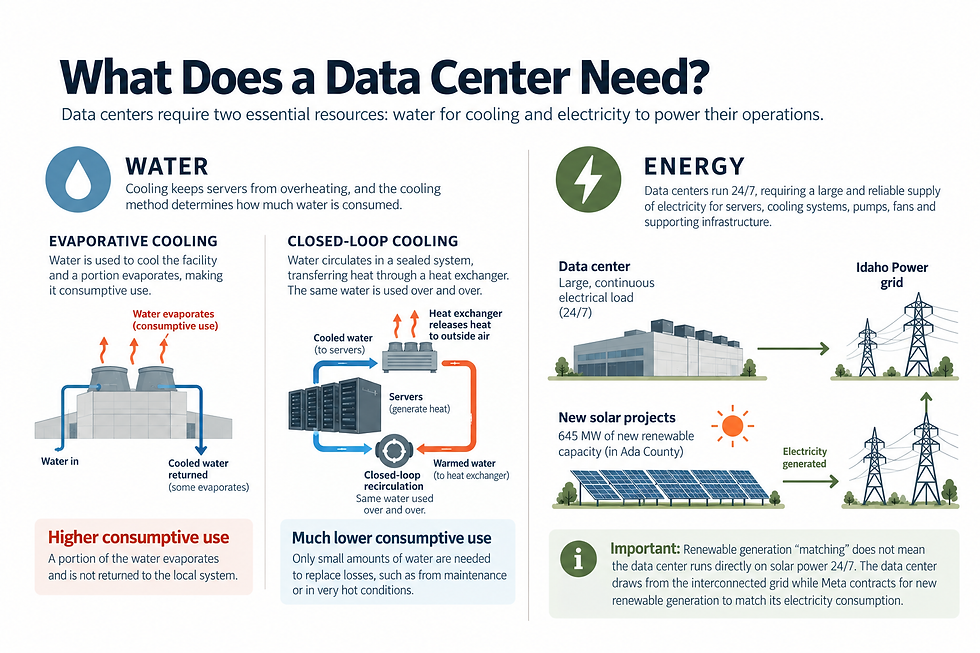
Many large cooling systems use evaporation to reject heat. Evaporation is remarkably effective at cooling, but it creates an important distinction from a water-resource perspective.
Water can be withdrawn without necessarily being consumed.
If water is withdrawn, used, treated, and returned to the local water system, much of it remains available within the watershed. Water that evaporates is different. It leaves the immediate local water system and is therefore considered consumptively used. So asking how much water a data center “uses” doesn't quite tell us what we really want to know.
We also need to ask:
How much does it consume?
Not All Data Centers Are the Same
Blaine County's ordinance illustrates the potential scale of the concern. It cites studies estimating that a medium-sized data center can consume as much as 300,000 gallons of water per day for cooling and that some very large facilities can consume as much as five million gallons per day. The ordinance also specifically identifies evaporative cooling as a source of consumptive use.
Those are attention-grabbing numbers. But they don't describe every data center.
Cooling technology, facility size, computing demand, climate, and operating practices can produce dramatically different water footprints. And Idaho now has an interesting example just a couple of hours down the road.
A Different Approach in Kuna
In September, Meta—the parent company of Facebook and Instagram—opened its new $1.2 billion data center in Kuna. The facility is enormous: roughly 750,000 square feet, with tens of thousands of servers estimated to be operating inside.

But something about the facility caught my attention.
Meta says the Kuna Data Center is only its second facility to use a new closed-loop liquid-cooling system designed to dramatically reduce water consumption.
Instead of continually bringing in new water and evaporating it to remove heat, approximately 200,000 gallons circulate through sealed cooling pipes, transferring heat from the servers much like coolant circulating through an enormous automobile radiator. According to Meta representatives interviewed by the Idaho Statesman, the facility used roughly one million gallons of water to flush and commission the system. Once operating, however, the same cooling water may remain in circulation for seven to ten years, assuming it isn't contaminated.
Meta says the facility can therefore operate with zero additional operational cooling water for the majority of the year.
That's a remarkably different water story from a facility consuming hundreds of thousands—or millions—of gallons every day.
It also made me curious.
So I contacted Meta and asked if I could come see it.
I explained that I work in river conservation in the Wood River Valley, that Blaine County was considering how to regulate data centers, and that I was trying to better understand how a modern facility could minimize its impact on water resources.
Meta declined the tour.
For business and security reasons, they explained, access to the facility is very limited and visits generally require considerable lead time. Instead, they pointed me toward information they have published about the Kuna facility and its approach to water and energy.
Fair enough.
But the published information leaves an interesting unanswered question.
Meta says Kuna uses zero operational water for cooling “for the majority of the year.”
What happens during the rest of it?
Company representatives told the Idaho Statesman that they did not yet know how much water would be needed for ancillary cooling, or how many days each year that additional cooling would be necessary. Because the facility only recently became operational, actual annual water-use data don't yet exist. Meta says those data will eventually be included in its sustainability reporting.
For a place like the Big Wood Basin, that missing information is particularly interesting.
Because when water is consumed can matter almost as much as how much is consumed.
A Gallon of Water Isn't the Same Gallon All Year
The Big Wood River is a snowmelt-driven system. Water is abundant during spring runoff and much less abundant later in the summer. As flows decline and temperatures rise, the ecological importance of the water remaining in the river can increase. Blaine County's ordinance recognizes this explicitly, noting that water availability in the Big Wood Basin is highly seasonal and that both the timing and consumptive nature of new water demands are relevant when considering their potential effects.
Imagine, for example, two hypothetical facilities that each consume the same amount of water annually.
One consumes most of its water during spring runoff.
The other requires its greatest amount of water during the hottest weeks of July and August.
On paper, their annual water consumption might look identical.
From the perspective of a river, they may not be identical at all.
That's one reason the unanswered question about Kuna's hottest days is so interesting.
It's also why simply quoting an annual water-use number doesn't tell us everything we need to know.
The Big Wood Is Already a Managed Water System
This conversation is occurring against an important backdrop.
The Big Wood Basin isn't a place with an unlimited pool of unused water waiting for a new demand. The Idaho Department of Water Resources already actively manages groundwater in the basin because of the relationship between groundwater pumping and surface-water availability. In 2022, IDWR established a moratorium on processing and approving new and pending applications to appropriate water within the Big Wood River Ground Water Management Area. Blaine County's ordinance also notes that management of the basin's interconnected groundwater and surface-water resources remains ongoing.
The reason is important:
Groundwater and surface water are connected.
It can be tempting to imagine groundwater and the Big Wood River as separate checking accounts.
Pump water from a well and, because the water isn't visibly coming out of the river, it can feel like an entirely different resource.
Hydrology is more complicated.
Depending on where a well is located and how the aquifer interacts with nearby surface waters, groundwater pumping can eventually reduce the amount of water reaching streams, springs, and wetlands. The timing and magnitude of those effects vary considerably across the landscape, but the connection itself is central to water management in the Big Wood Basin. That means a large new groundwater demand can't necessarily be considered independently from the river.
Water Isn't the Only Resource Question
The more I looked into data centers, the more apparent it became that water is only one part of the story.
Modern data centers also consume enormous amounts of electricity. Servers operate continuously. So do networking equipment, cooling systems, pumps, fans, and the other infrastructure that keeps them running.
The scale of Meta's Kuna project offers some perspective.
Meta has supported three new solar projects in Ada County totaling 645 megawatts of generating capacity. The company says those projects allow the electricity consumed by the Kuna Data Center to be matched with 100 percent clean and renewable energy.
That 645-megawatt figure requires some context.
It does not mean the Kuna Data Center continuously consumes 645 megawatts of electricity. Nor do those solar projects continuously generate that amount. Solar generation changes throughout the day and, obviously, stops at night.
Still, the scale is striking.
The Idaho Statesman compared the 645 megawatts of new solar capacity associated with the project with Idaho Power's all-time record system load. On that basis, the solar projects' combined maximum generating capacity is equivalent to roughly 17 percent of Idaho Power's record peak demand.
That comparison helps put the physical infrastructure behind our digital lives into perspective.
Matching Demand With New Energy
Meta worked with Idaho Power years before the Kuna facility opened to plan for its electrical demand. Importantly, the data center isn't connected directly to a private solar farm that powers its servers whenever the sun is shining. It remains connected to Idaho Power's broader electrical grid. Electricity from many sources enters that interconnected system, while the data center draws power from it around the clock. Meta contracts for new renewable generation so that renewable electricity added to the grid matches the electricity consumed by the facility over the relevant accounting period.
That's an important distinction.
“Powered by 100 percent renewable energy” can create the impression that the servers shut off when the sun goes down.
They don't.
The electrical grid still has to reliably serve the facility every hour of every day—including at night, during periods of peak demand, and when renewable generation is low. But adding new generating capacity to accommodate a major new load is considerably different from simply placing that demand onto the existing electrical system without planning for it.
There is an interesting parallel here with water.
With water, the headline number doesn't tell us enough. We need to understand how much is withdrawn, how much is actually consumed, where it comes from, and when that consumption occurs. With electricity, annual consumption alone doesn't tell us everything either. We also need to understand peak demand, when that demand occurs, and what generation and transmission infrastructure are required to serve it.
In both cases, design and planning matter enormously.
Efficiency Changes the Conversation
Perhaps the most interesting thing about Kuna isn't whether Meta has built a “good” or “bad” data center. It's that the facility demonstrates how much engineering choices can change the environmental footprint of the same basic infrastructure. Closed-loop cooling can dramatically reduce consumptive water use compared with heavily evaporative systems.
New generation can be developed alongside new electrical demand.
Water and wastewater infrastructure can be designed with reuse and efficiency in mind.
None of these choices makes the facility impact-free.
But they do demonstrate something important:
The environmental footprint of a data center isn't determined solely by its size. It's also determined by how we choose to build it.
And that leads to a potentially more constructive question for water-limited communities:
If technology already exists to substantially reduce consumptive water use, what level of water efficiency should we expect from new facilities?
The Question Is Bigger Than Water
This is where I think the conversation becomes especially relevant to a land trust.
Water may be what brought data centers into this discussion, but a data center is also a land-use decision.
Large facilities occupy substantial physical footprints. They can require roads, substations, transmission infrastructure, fiber, water and wastewater systems, and hundreds of thousands—or potentially millions—of square feet of buildings. Once land is converted to that kind of use, returning it to agriculture, wildlife habitat, open space, or another use isn't necessarily simple.
That matters in a place like Blaine County.
Here, communities, agriculture, housing, recreation, wildlife habitat, migration corridors, open space, and economic development all share a finite landscape.
Of course, the impact depends enormously on where development occurs. A data center constructed on already-developed industrial land presents a very different conservation question from one that converts productive agricultural ground, fragments wildlife habitat, or requires substantial new utility corridors.
But that is precisely why location matters.
And it raises a question that goes beyond gallons of water or megawatts of electricity:
What uses of land and natural resources will provide lasting value to our communities?
Data centers undoubtedly provide value. The digital infrastructure they house increasingly supports essential functions of modern society, as discussed. But technology also changes remarkably quickly. The useful life of individual servers may be measured in years. Buildings, substations, transmission corridors, water infrastructure, and changes in land use can remain on the landscape for decades.
That doesn't mean we shouldn't build data centers.
It means communities should evaluate them with the same long-term thinking we apply to other major infrastructure.
A proposal shouldn't be judged solely by what it provides today.
We should also ask what it commits the landscape to tomorrow.
What Should We Ask Before One Arrives?
Perhaps that is the opportunity presented by Blaine County's current conversation. The County doesn't have to wait until a specific project is on the table to decide what information matters.
In fact, the moratorium directs County staff to work toward a permanent approach to the issues identified during the moratorium period. That creates an opportunity to ask some fundamental questions in advance.
How much water would a facility withdraw—and how much would actually be consumed?
Where would that water come from?
What cooling technology would it use?
What would peak water demand look like during July and August?
What happens during drought?
Could reclaimed or non-potable water be used?
How would groundwater withdrawals affect connected surface waters?
How much electricity would the facility require, and what new generation and transmission infrastructure would be necessary to reliably serve it?
How much land would be converted?
Would agricultural ground, wildlife habitat, migration corridors, or open space be affected?
Could existing industrial land accommodate the development instead?
Could the buildings and infrastructure be adapted to another use if computing technology changes?
What responsibility should developers have to address the environmental impacts of their projects?
And once the facility became operational, would actual water and energy consumption be publicly reported?
And perhaps one question above all:
Will the value this infrastructure provides decades from now justify what we ask the landscape to give up today?
We don't necessarily need to know the answer before a proposal arrives.
But we should know what questions we intend to ask.