.png)
What Is Restoration — And How Do We Know It’s Working?
Updated: Apr 28
From moving dirt to measuring change

When people hear the word restoration, they often picture heavy equipment in a river —
reshaping channels, planting vegetation, and reconnecting floodplains.
And to be fair, that’s part of it.
But restoration isn’t the work you see on the ground.
It’s the change that happens after.
What Is River Restoration?
At its core, river restoration is about recovering the processes that allow a river to function on its own.
That means:
reconnecting floodplains
restoring channel complexity
slowing water down and spreading it out
allowing sediment, wood, and nutrients to move and settle naturally
The goal isn’t to build a perfect river.
It’s to rebuild the conditions that let a river shape itself.
Because when those processes are working, everything else follows — habitat, water quality,
resilience, and ultimately, the fishery.
The Harder Question: How Do We Know It’s Working?
This is where things get more complicated.
Rivers are dynamic systems. They respond to floods, drought, wildfire, upstream conditions, and time. Change doesn’t happen all at once — and it doesn’t always look the way we expect.
So how do you measure success?
At the Wood River Land Trust, we look at restoration from multiple angles — because no single metric tells the whole story.
What We Measure
Some of our tools are straightforward.
Redd counts help us understand how fish are using the river — where they’re spawning, and
whether habitat is supporting reproduction. A redd is a "nest" or gravel bed created by female trout to lay their eggs, typically appearing as a clean, bright spot in the streambed during spawning periods. We conduct Redd counts throughout the Hailey Greenway and across our project reaches up and down the valley.

Figure 1 . Here, a trout Redd is observed at Rock Creek. Redd's are distinguished by the four D's: digging, depression, definition, and disturbance. All four can be seen in the photo above.
Photo point monitoring allows us to track visual change over time — how channels and log jams evolve, how vegetation establishes, how floodplains respond.
Drone imagery gives us a broader perspective — showing how the river moves across the landscape, how side channels form, and how complexity develops.
Other tools go deeper (literally).
In some projects, we install piezometers to measure groundwater levels. When we reconnect a floodplain, we expect the water table to rise — rehydrating soils, supporting vegetation, and increasing exchange between surface water and groundwater.

Figure 2. A stream piezometer is a specialized device used to measure groundwater levels within the saturated sediment beneath or beside a stream. By comparing this water level to the nearby stream stage, we can determine if groundwater is recharging in response to restoration treatments.
And in certain cases, we look at macroinvertebrates — the insects that form the base of the aquatic food web. These communities respond to changes in habitat, water quality, and nutrient dynamics, offering insight into how the system is functioning beneath the surface.
Each of these tells us something different.
Together, they begin to tell a story.
A Deeper Look: What’s Happening Beneath the Surface
Some of the most important changes in a restored river aren’t visible at all.
A recent study on Whychus Creek in Oregon looked at what happens when a stream is reconnected to its floodplain — not just in terms of habitat, but at the level of the food web.
The findings are worth paying attention to.
When the stream was reconnected to its floodplain:
Water slowed down and spread out across the valley
The water table rose, rehydrating the floodplain
Organic matter and nutrients were retained instead of being flushed downstream
But the most interesting changes happened at the foundation of the ecosystem.
Diatoms — microscopic algae that form the foundation of the aquatic food web — shifted in composition. Species that thrive in fast, simplified channels were replaced by a more diverse community associated with slower water and more complex habitat.
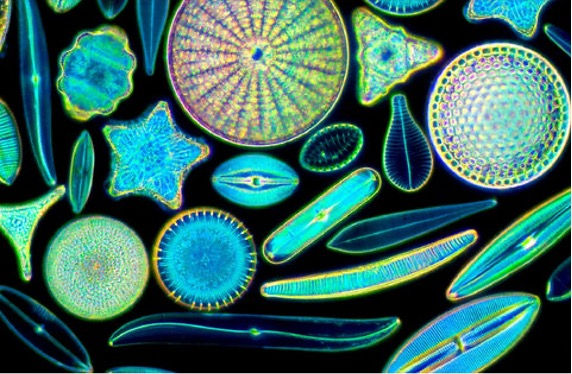
Figure 3. Diatoms are unicellular algae. Diatoms are microscopic in size, live in water, soil and moist environments, and exhibit highly ornamented glass houses made of silica with two parts that fit together like a Petri dish. Diatoms play an important role in producing about 20% of the earth’s oxygen and form an important part of the food chain feeding other aquatic life.
Photo: Motic Microscopes
At the same time, nutrient dynamics changed.
The restored system showed signs of increased nutrient availability and cycling, likely driven by enhanced exchange between surface water and the hyporheic zone — the area beneath and alongside the streambed where water, sediment, and biology interact.
Those changes didn’t stay at the bottom of the food web.
Using stable isotopes, researchers found evidence of a “bottom-up” response — where increased nutrient availability led to changes in macroinvertebrates and even riparian vegetation. In other words, restoring physical processes in the river influenced the entire ecosystem, from algae to insects to plants.
This is the kind of change that’s easy to miss if you’re only looking at the surface.
So What? From Measuring Change to Understanding Recovery
All of this leads to a bigger question:
What are we actually trying to restore?
One way to think about it is through the idea of a river’s nutrient cycle — sometimes described as a “nutrient spiral.”
In a healthy river, nutrients don’t just move downstream and disappear. They are taken up by algae, incorporated into the food web, broken down by bacteria, and then reused again — over and over, as they slowly move through the system.
But in a channelized, disconnected stream, that cycle breaks down.
Water moves quickly. Nutrients are flushed downstream. The river becomes efficient at transporting water — but less capable of supporting life.
When we reconnect a river to its floodplain, something fundamental changes.
Water slows down. It spreads out. It moves into side channels and wetlands. It interacts with the soil and the hyporheic zone beneath the streambed — places where organic matter is stored, broken down, and transformed into nutrients that feed the system.
In these conditions, the nutrient cycle tightens.
Energy is retained longer. Food becomes more available. The system becomes more productive — not just in the main channel, but across the entire riverscape.
That’s where side channels and floodplain habitats become critical. These areas support entirely different communities of algae, insects, and zooplankton — all of which play an outsized role in feeding fish, especially at early-life stages.
Warm Springs Preserve – a Case Study
Much of what we know about these processes comes from studies like those on Whychus Creek — but those studies often have a limitation.
They don’t always have data from before restoration.
Which makes it harder to fully understand how much has changed — and why.
That’s what makes the work at Warm Springs Preserve so important.
Here, we have the opportunity to measure the system both before and after restoration — tracking how the river responds not just in form, but in function.
In partnership with researchers, this work is part of a broader effort spanning multiple rivers across the western United States and even into England — all designed to better understand how restoration influences river productivity and ecosystem health.
At Warm Springs, we’re not just building side channels, adding wood, or reconnecting floodplain areas.
We’re creating the conditions for these deeper processes to return — and then measuring how they respond.
What We’re Really Looking For
If restoration is working the way we hope, we should see more than just a different-looking river.
We should see:
tighter nutrient cycles
increased productivity at the base of the food web
more diverse and abundant invertebrate communities
better support for fish, especially during critical life stages
In other words, we’re not just asking:
Did the river change?
We’re asking:
Is the river working again?
Looking Ahead
Restoration often focuses on the visible — channels, banks, and vegetation.
But as this research reminds us, some of the most important changes happen at a much smaller scale.
In the movement of nutrients.In the exchange between water and soil.In the microscopic organisms that power the entire system.
Because in the end, restoring a river isn’t just about rebuilding its shape. It’s about restoring its ability to sustain life. The real measure of restoration isn’t what we build — it’s what the river remembers how to do on its own.
Cory McCaffrey
River Program Director

