.png)

Improving Wildlife Connectivity
Across Our Highways
Regional stakeholders develop "Blaine County, Idaho Wildlife-Vehicle Conflict Assessment and Long Range Mitigation Plan"
The Wood River Valley community cherishes the beautiful and abundant wildlife of its surrounding mountains and watersheds. The valley itself is a wildlife corridor, yet us humans have settled in it. The human impact on habitats in the Wood River Valley is undeniable, and will persist as long as the cities exist in the valley floor. To mitigate these impacts, coalitions like the Wood River Valley Wildlife Smart Communities or the Wildlife-Vehicle Conflict Subcommittee of the Blaine County Regional Transportation Committee are working on solutions to relieve the pressure points where conflict happens and wildlife suffer.

A major area of concern is wildlife-vehicle collisions in Blaine County. The following resources are available for you to read more about the long-distance migration routes across the region, the local resident elk herd, the rate of wildlife-vehicle collisions in the county, the history of mitigation measures that improve wildlife connectivity, the current context of highway widening and infrastructure projects, and the local effort to develop the "Blaine County, Idaho Wildlife-Vehicle Conflict Assessment and Long Range Mitigation Plan."
Developing a Long-Range Mitigation Plan for Wildlife-Vehicle Conflict in Blaine County:
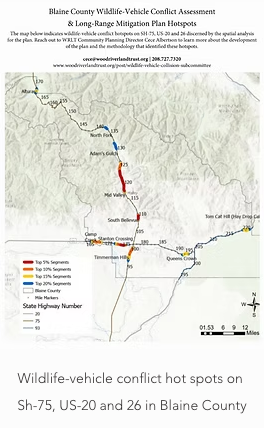
As part of the Wildlife-Vehicle Conflict Subcommittee of the Blaine County Regional Transportation Committee, the Wood River Land Trust is coordinating the development of an Assessment and Long-Range Mitigation Plan for Wildlife-Vehicle Conflict in Blaine County. Technical advisors from 10 separate government, land management, conservation and transportation planning organizations have steered the data analysis and are now deliberating recommendations for mitigation measures at the following wildlife-vehicle collision (WVC) hot spots on SH-75, US-20 and 26. Ten local and regional data sources for wildlife-vehicle collisions, habitat suitability and wildlife connectivity were used to prioritize the WVC hotspots.
Please reach out to learn more or get involved!
Cece Albertson, Community Planning Director at the Wood River Land Trust
cece@woodriverlandtrust.org | 208.727.7320
Background information:
-
Long-Distance Migration Routes versus the Resident Elk Herd Movements
-
Rate of Wildlife-Vehicle Collisions (WVC) in Blaine County
-
History of Wildlife Connectivity Planning & Measures in Blaine County
-
Highway Widening: Current SH-75 Infrastructure Projects
-
What solutions are out there?
-
2024-2026: Wildlife-Vehicle Collision Public Subcommittee Materials